Badger Boards
Badger Family
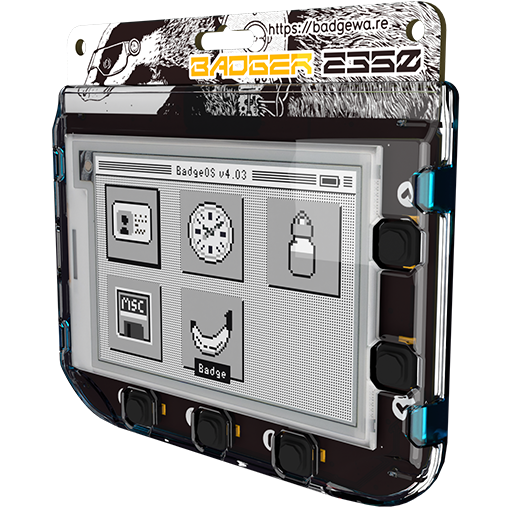
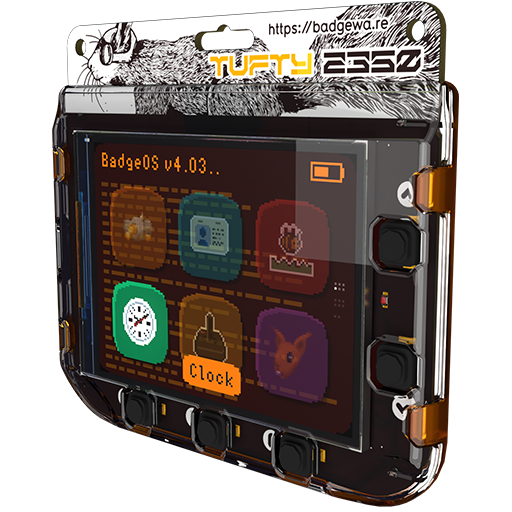
The Bagder board family consists of three smart interactive badges, each featuring a different display technology but sharing the same core hardware platform based on the Raspberry Pi RP2350 microcontroller. The badges are designed for wearable applications, with built-in rechargeable batteries, wireless connectivity, and a sturdy polycarbonate case.
| Badger | Tufty | Blinky |
|---|---|---|
 |
 |
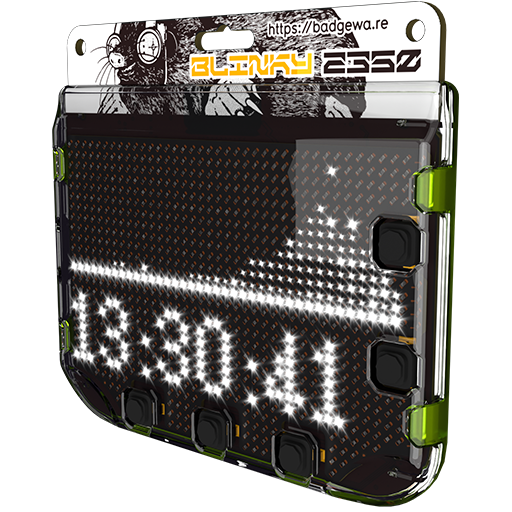 |
| E-Paper display | Full-colour TFT LCD | Mono LED matrix |
| 2.7" 264×176 greyscale e-paper display | 2.8" 320×240 full-colour IPS LCD | 3.6" 872 white mono LEDs (39×26 matrix) |
The base hardware platform includes:
| Feature | Details |
|---|---|
| Processor | Raspberry Pi RP2350 microcontroller (dual Arm Cortex M33 @ 250 MHz, 520 KB SRAM) |
| Flash | 16 MB QSPI flash (execute-in-place) |
| PSRAM | 8 MB PSRAM |
| Wireless | Raspberry Pi RM2 wireless module (CYW43439) for WiFi and Bluetooth connectivity |
| Battery | 1000 mAh rechargeable LiPo battery MCP73831 charger IC for 455mA USB-C charging XB6096I2S battery protector for over-charge and over-discharge protection |
| RTC | PCF85063A real-time clock (wake-from-sleep capable) |
| Buttons | 5 front user buttons Reset/Sleep button Home/Boot button |
| Connectors | USB-C for charging and programming I2C connector for connecting external breakouts such as Qwiic/STEMMA QT |
| Dimensions | 84 mm (W) × 76 mm (H) × 20 mm (D) with case |
Processor & Memory
At the heart of the Badger 2350 is the Raspberry Pi RP2350A, a powerful dual-core microcontroller.
- CPU: Dual Arm Cortex-M33 cores running at up to 250 MHz
- SRAM: 520 KB on-chip
- Flash: 16 MB QSPI with execute-in-place (XiP)
- PSRAM: 8 MB — plenty of room for images, fonts, and data buffers
Wireless Connectivity
The badge includes a Raspberry Pi RM2 wireless module based on the Infineon CYW43439 chipset:
- Wi-Fi: IEEE 802.11 b/g/n (2.4 GHz)
- Bluetooth: 5.0 (BLE supported)
This enables over-the-air updates, fetching live data from APIs, MQTT messaging, and more.
Power & Battery
The built-in rechargeable lithium polymer battery keeps the Badger running for extended periods, especially when leveraging deep sleep modes.
| Component | Specification |
|---|---|
| Battery | 1000 mAh LiPo |
| Charger IC | MCP73831 (455 mA charging current) |
| Protector | XB6096I2S (over-charge / over-discharge protection) |
| Charging | Via USB-C |
Tip: Use the PCF85063A real-time clock to schedule wake-ups from deep sleep, keeping power consumption to an absolute minimum between display updates.
Real-Time Clock (RTC)
- IC: PCF85063A
- Function: Maintains accurate time while the main processor is in deep sleep
- Wake-up: Can trigger the RP2350 to wake at a scheduled time for periodic updates (e.g., refresh a weather display every 15 minutes)
Buttons
The Badger 2350 provides a total of seven physical buttons:
| Button | Location | Function |
|---|---|---|
| A – E | Front | Five programmable user buttons |
| Reset | Edge | Reset the processor / enter sleep mode |
| Home | Edge | Return to the home screen / enter boot mode for flashing firmware |
Connectors
| Connector | Purpose |
|---|---|
| USB-C | Charging the battery and programming via USB serial |
| I2C Qwiic / STEMMA QT | Plug-and-play connection for I2C breakout boards |
| SWD | Serial Wire Debug for advanced debugging |
Badger 2350
The Badger 2350 uses a 2.7-inch electronic paper (E-Paper / E-Ink) display capable of rendering four levels of greyscale. E-Paper is reflective, meaning it looks great in direct sunlight and consumes zero power to maintain an image on screen.
- Resolution: 264 × 176 pixels
- Greyscale levels: 4 (black, dark grey, light grey, white)
- Technology: Electronic paper (bistable — holds image with no power)
Perfect for low-power information displays, pixel art, and slow-paced games. Programmable with MicroPython — no soldering required.
Tufty 2350
The Tufty 2350 is a smart, interactive badge featuring a vibrant 2.8" full-colour TFT IPS LCD display.
- Type: 2.8" full-colour TFT IPS LCD
- Resolution: 320 × 240 pixels
- Backlight: Adjustable brightness
- Light sensor: On-board phototransistor for ambient light sensing (useful for auto-brightness or light-reactive apps)
Perfect for mini dashboards, fast-paced games, and eye-catching widgets — programmable with MicroPython and no soldering required.
Blinky 2350
The Blinky 2350 is a smart interactive badge featuring a bright white LED matrix display.s
- Type: White mono LED matrix with individually adjustable brightness
- LED count: 872 LEDs arranged in a 39 × 26 matrix, minus 'islands'
- LED drivers: FM6047 constant current LED drivers
- Case lighting: 4-zone mono LED backlighting around the case edge
Perfect for pixel art, animations, and simple games.
we use privacy-first analytics
that don't track you with cookies.
no personal data is collected.
GDPR & CCPA compliant.