Soft skills

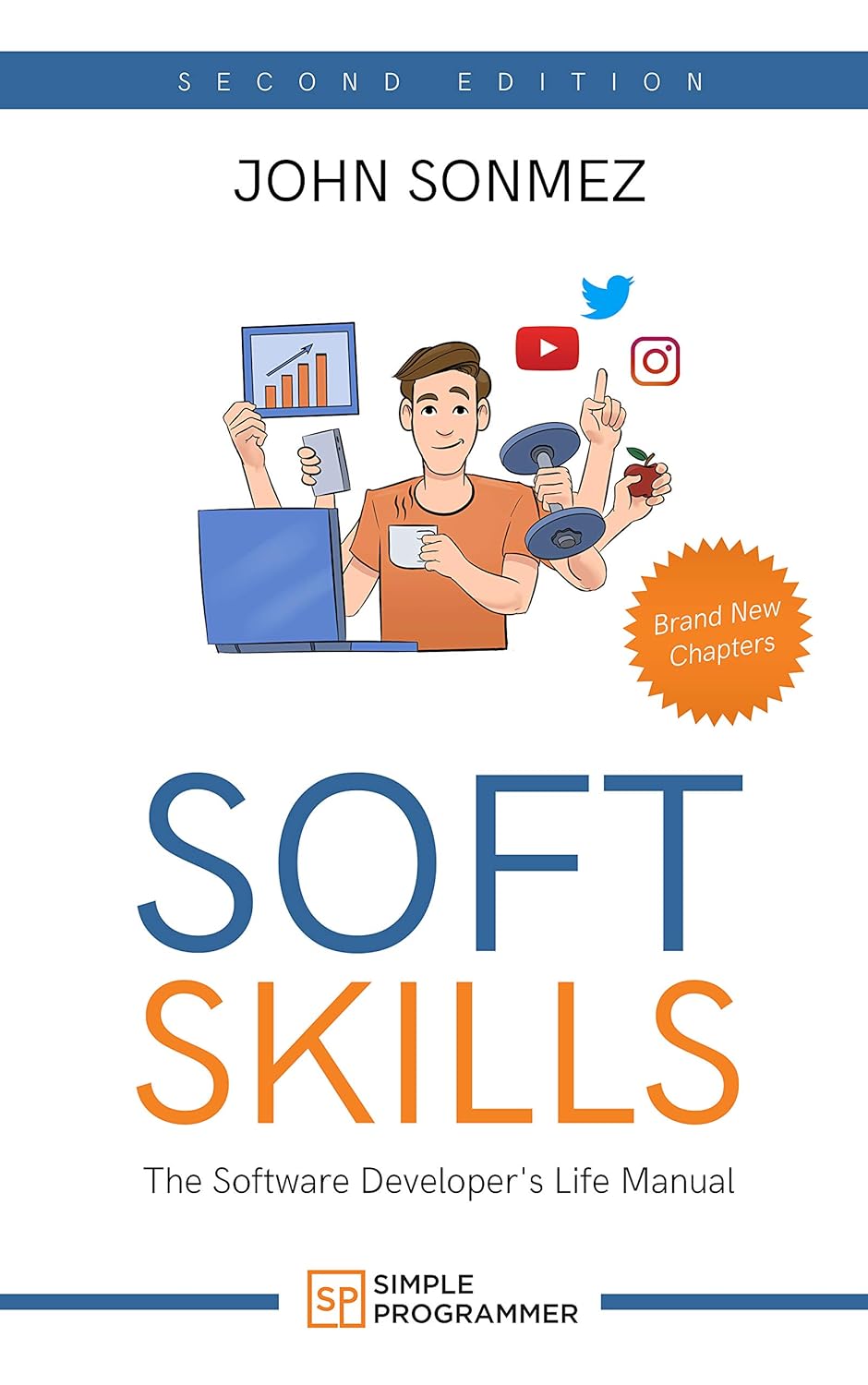
My short summary on how to apply the key elements from the book Soft Skills - The Software Developer's Life Manual by John Sonmez.
Treat Your Career Like a Business
- Write a "business statement" for yourself: "I provide X value to Y type of clients/companies."
- Example: "I provide scalable web applications and mentoring to fast-growing startups."
- Update your CV, LinkedIn, and webpage to reflect your value.
- Evaluate yearly whether you need new “products” (skills).
- Keep a list of clients (employers/partners) and nurture those relationships.
Set Clear, Long-Term Goals
- Define your 10-year target (one sentence).
- Format: "By [date], I will be [specific role] at [type of company] earning [amount] because I'm known for [expertise]."
- Break it down:
- 3-year goal
- 1-year goal
- Quarterly goals
- Weekly actions
- Review goals every Sunday for 10 minutes.
- Track progress in a simple tool (Notion, Obsidian, OneNote).
Improve People Skills
- In every meeting:
- Let the other person speak first.
- Ask clarifying questions: "Can you help me understand..." "What would success look like for you..."
- Mirror their priorities ("What matters most to them?").
- Practice zero criticism: when you want to correct, ask a question instead.
- Instead of: "That won't work because..."
- Try: "What challenges do you foresee with that approach?"
- Read (and apply) How to Win Friends and Influence People.
- Once per week, do one positive interaction email/message.
Market Yourself
- Pick one channel:
- Blog, LinkedIn, YouTube, conference talks.
- Produce one piece of content per week (short and simple).
- Examples: 300-word blog post about a problem you solved, LinkedIn post sharing a lesson learned, 5-minute video explaining a concept.
- Share your work publicly: projects, insights, slides.
- Build an “expert sphere”: choose your niche and talk about it repeatedly.
Learn How to Learn
Follow the 10-step learning loop:
- Define exactly what you want to learn
- Research and gather materials
- Create a learning plan (timeline: 2-4 weeks for most skills)
- Learn basics quickly (20% of time)
- Build a small project (practical application)
- Deep dive into missing topics
- Practice deliberately
- Teach what you learned (blog, a colleague)
- Repeat
- Measure progress
Boost Productivity
- Use Pomodoro (25 min focus => 5 min break).
- Tools: Forest app, Toggl, simple timer
- Break activities: stretch, walk, hydrate (avoid social media)
- Create a fixed daily routine:
- Morning = creative work
- Afternoon = meetings
- Avoid multitasking: close all tabs except the project you’re doing.
- Start the day with a top 3 list:
- “If I only finish these three tasks, today is a success.”
- Every Friday: weekly review.
Prevent / Recover From Burnout
Warning signs to watch for:
- Dreading work, constant fatigue, irritability, decreased productivity
Prevention & Recovery:
- Reduce cognitive load - choose fewer goals.
- Introduce minimal fitness (walking, stretching).
- Create hard barriers:
- No work after 19:00
- No email on weekends
- Find purpose: reconnect your work to what matters to you.
- Take one full day off per week with no obligations.
- Rate your energy levels 1-10 weekly - track patterns
- If symptoms persist > 2 weeks, consider professional help
Build Wealth Early
- Negotiate salary with each job change.
- Research market rates on Glassdoor, Levels.fyi
- Ask for 15-20% more than current salary when switching
- Avoid all debt except mortgage.
- Pay yourself first: automatic savings/investment (10–20%).
- Invest long-term (real estate or index funds).
- Track your net worth every month.
- Tools: Mint, YNAB, or simple spreadsheet
Build a Winning Mindset
- Practice Stoicism:
- Control what you can
- Accept what you cannot
- Train discomfort
- Reprogram your self-image:
- Daily affirmations
- Act “as if” you already are the person you want to be
- Do one uncomfortable thing per day.
- Reflect daily (journaling).
Strengthen Relationships
- Schedule weekly time for partner/family.
- Give appreciation regularly (verbal or written).
- Use the assume positive intent rule.
- When in conflict: listen => repeat back => respond calmly.
Quick Reference Cheat Sheet
Weekly Habits to Start:
- Week 1-2: Daily top 3 list + Pomodoro technique
- Week 3-4: Practice people skills (ask questions first)
- Week 5-6: Create one piece of content weekly
- Week 7-8: 10-minute Sunday goal review
Monthly Tracking:
- Net worth calculation
- Energy levels (burnout check)
- Goal progress review
- Content creation streak
Essential Tools:
- Pomodoro: Forest app, Toggl
- Finance: Mint, YNAB
- Learning: Notion, Obsidian
- Networking: LinkedIn, Twitter
we use privacy-first analytics
that don't track you with cookies.
no personal data is collected.
GDPR & CCPA compliant.